c. 2670 BCE
The Step Pyramid at Saqqara
Djoser's architect Imhotep stacks six diminishing mastabas into the first monumental stone building anywhere. It is the moment the technique begins.
Section 06
Forty-six centuries in one column. Note how much of it is not construction at all, but people arriving afterwards to dig, measure, argue about, quarry and photograph what was already there.
Before Giza
Djoser's architect Imhotep stacks six diminishing mastabas into the first monumental stone building anywhere. It is the moment the technique begins.
Khufu's father builds at Meidum and twice at Dahshur. The Bent Pyramid changes angle part-way up — a mid-construction correction, probably for stability. The Red Pyramid that follows is the first successful true pyramid, and the template for Giza.
The Fourth Dynasty at Giza
Khufu moves the royal necropolis to the Giza plateau and builds the largest pyramid ever attempted. A harbour, a workers' town and a planned field of mastabas go up alongside it.
The second pyramid is built higher up the slope with a steeper face. Its causeway, valley temple and — on the current consensus — the Great Sphinx are all cut as one integrated scheme.
The third and smallest pyramid, cased in Aswan granite. The king dies before the casing is dressed; his successor Shepseskaf finishes the temples in mud brick.
Antiquity
A New Kingdom pharaoh digs the sand out of the Sphinx enclosure and erects the Dream Stele between its paws to record why. The monuments are already more than a thousand years old.
The Greek historian visits and writes down what the guides tell him — a hundred thousand labourers, twenty years, and a slander about Khufu that has stuck to him ever since.
Antipater of Sidon names the pyramids in his catalogue of marvels. They are the only entry on that list still standing.
The medieval and early modern plateau
Al-Malik al-Aziz Uthman, a son of Saladin, sets out to pull the pyramids down. Eight months of work on Menkaure's produce one large scar and a ruined budget.
A major quake shakes loose much of the smooth Tura limestone casing. The fallen blocks are carted off to build Cairo, leaving the stepped cores we see today.
Al-Maqrīzī records that a Sufi named Muhammad Sa'im al-Dahr attacks the face with chisels and is killed by locals for it. The nose has been missing ever since — and Napoleon's army will not arrive for another four hundred years.
The century of measurement
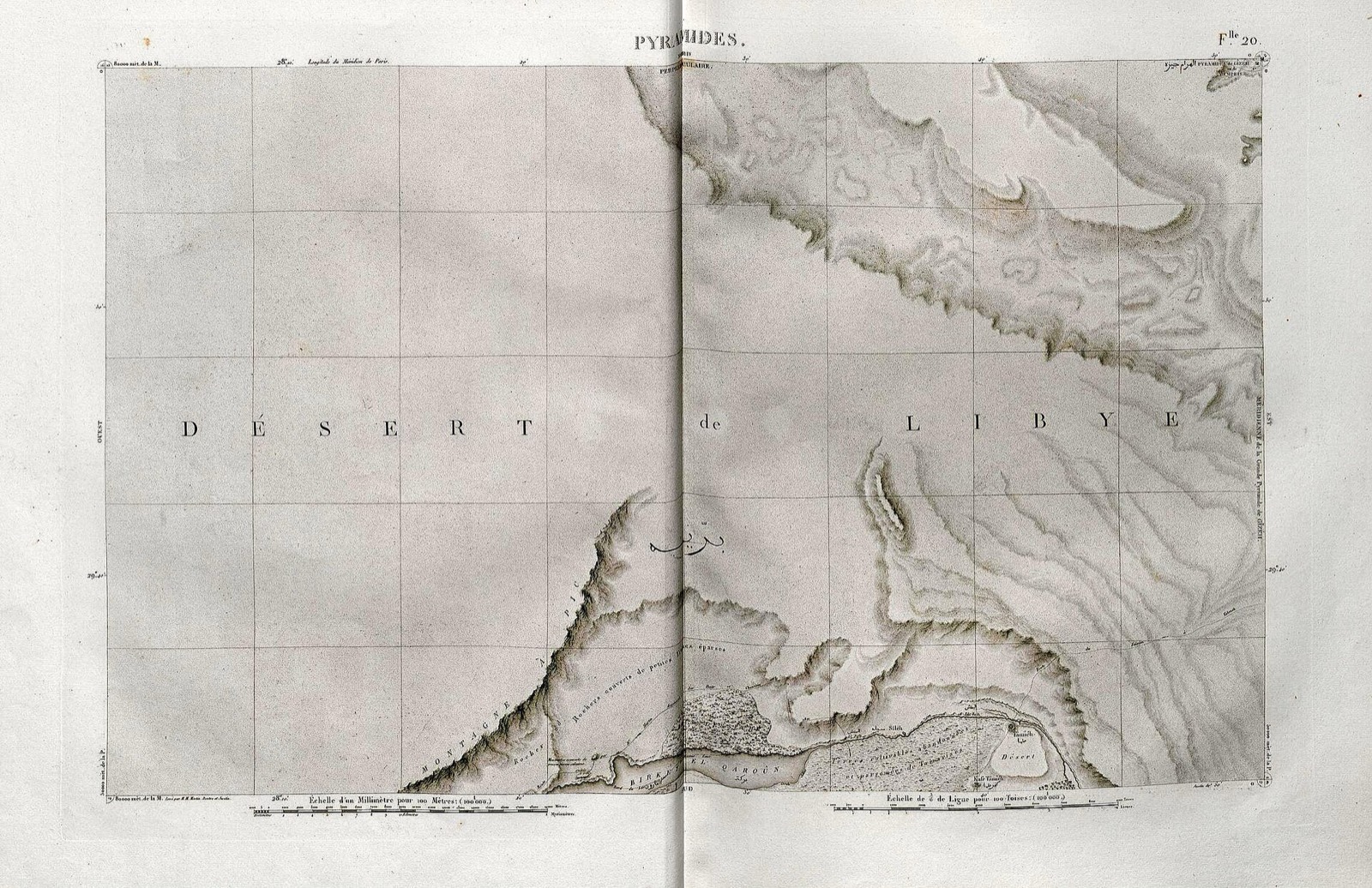
The French expedition brings 160 scholars, engineers and draughtsmen. They survey and draw everything they can reach.
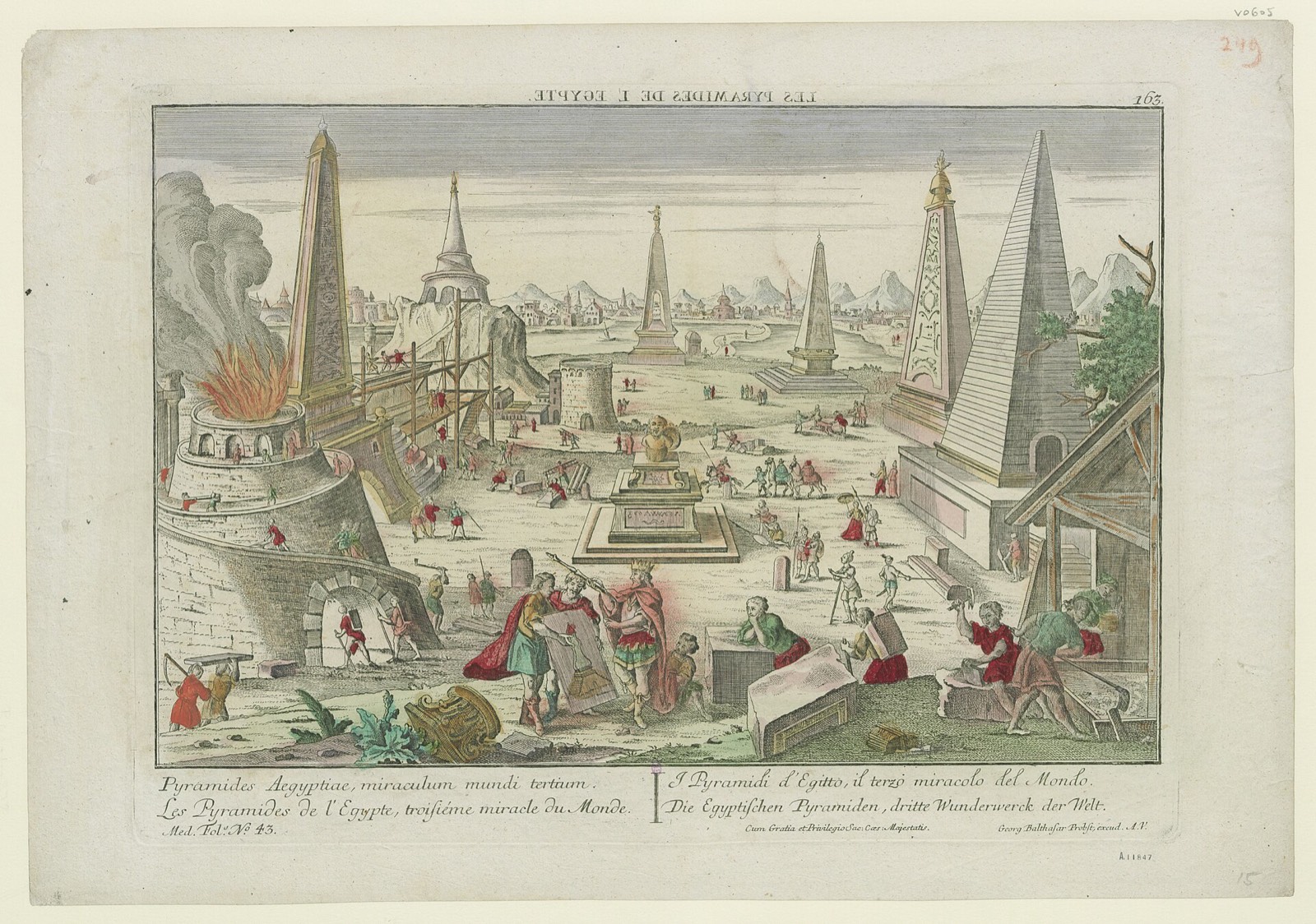
The expedition's results are published in enormous folio volumes. Most of the engraved plates in this guide come from them — accurate in survey, imaginative in atmosphere.
Howard Vyse blasts into the relieving chambers above the King's Chamber and finds quarry graffiti naming Khufu — still the only inscription in the pyramid identifying its owner.
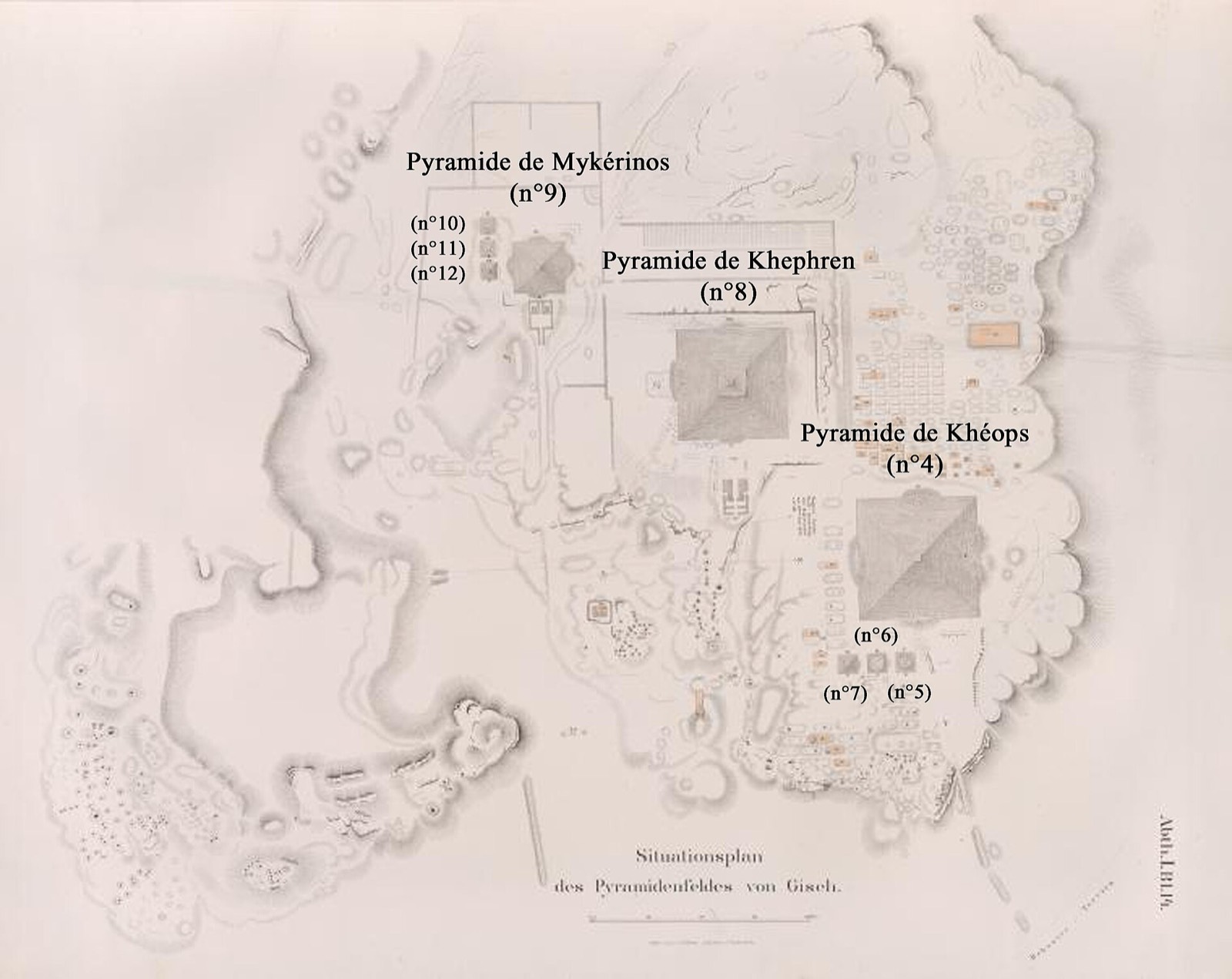
A Prussian team under Karl Richard Lepsius produces the first systematic survey map of the necropolis and records tomb after tomb in the mastaba fields.
Félix Bonfils, the Zangaki brothers and Francis Frith set up commercial studios and sell albumen prints to travellers. Their negatives are the first mechanical record of the site.
Flinders Petrie lives in a rock-cut tomb on the plateau and surveys the Great Pyramid with instruments precise to fractions of a millimetre. His numbers are still the ones people quote.
Modern excavation
George Reisner's Harvard–Boston expedition works the cemeteries for forty years, developing much of the recording practice that modern field archaeology still uses.
A photographer's tripod leg breaks through plaster over a hidden shaft. At the bottom is the burial equipment of Khufu's mother — gilded furniture, a carrying chair, a sealed alabaster sarcophagus. The sarcophagus turns out to be empty.
Émile Baraize excavates the enclosure down to bedrock and consolidates the body. This is the campaign that leaves the Sphinx as visitors see it now.
Kamal el-Mallakh opens a sealed pit on the south side and finds 1,224 pieces of a dismantled cedar ship, 43.6 metres long, with its ropes intact.
Mark Lehner and Zahi Hawass excavate Heit el-Ghurab and the workers' cemetery, replacing the slave-labour story with bakeries, breweries, named gangs and evidence of long-term medical care.
Now
Pierre Tallet's team finds the oldest inscribed papyri in the world at Wadi al-Jarf — including the working diary of a boat captain hauling casing stone to Giza while the Great Pyramid was being finished.
The ScanPyramids project images the Great Pyramid with cosmic-ray muons and reports a previously unknown space at least thirty metres long above the Grand Gallery.
A nine-metre corridor behind the chevron blocks on the north face is confirmed and inspected with an endoscope. It appears to be structural.
After two decades of construction, the museum on the edge of the plateau opens in full — with the reassembled Khufu ship, moved there in 2021, among its centrepieces.