Section 05
How It Was Built
No wheels for haulage, no pulleys, no iron, no draught animals doing the heavy lifting. Copper, stone, wood, rope, water, ramps — and an administrative machine capable of feeding a small city in the desert for twenty years.
Core masonry, roughly dressed.
Granite beams over the King's Chamber, from Aswan.
Aswan to Giza, downstream by barge.
From the excavated workers' town, not from Herodotus.
Three different stones, from three different distances, for three different jobs.
The core — the overwhelming bulk of every pyramid — is local. It was quarried a few hundred metres from where it was laid, in pits that are still visible on the plateau. This stone is coarse and full of fossil shells, and it did not need to be beautiful because it was never going to be seen. Blocks were cut by chiselling separation trenches around three sides and then splitting the block free from the bedrock beneath.
The casing is fine white limestone from Tura, on the opposite bank of the Nile. It had to cross the river, but only just — a few hours by barge during the inundation, when the floodwater came close to the quarry mouth at one end and the plateau harbour at the other.
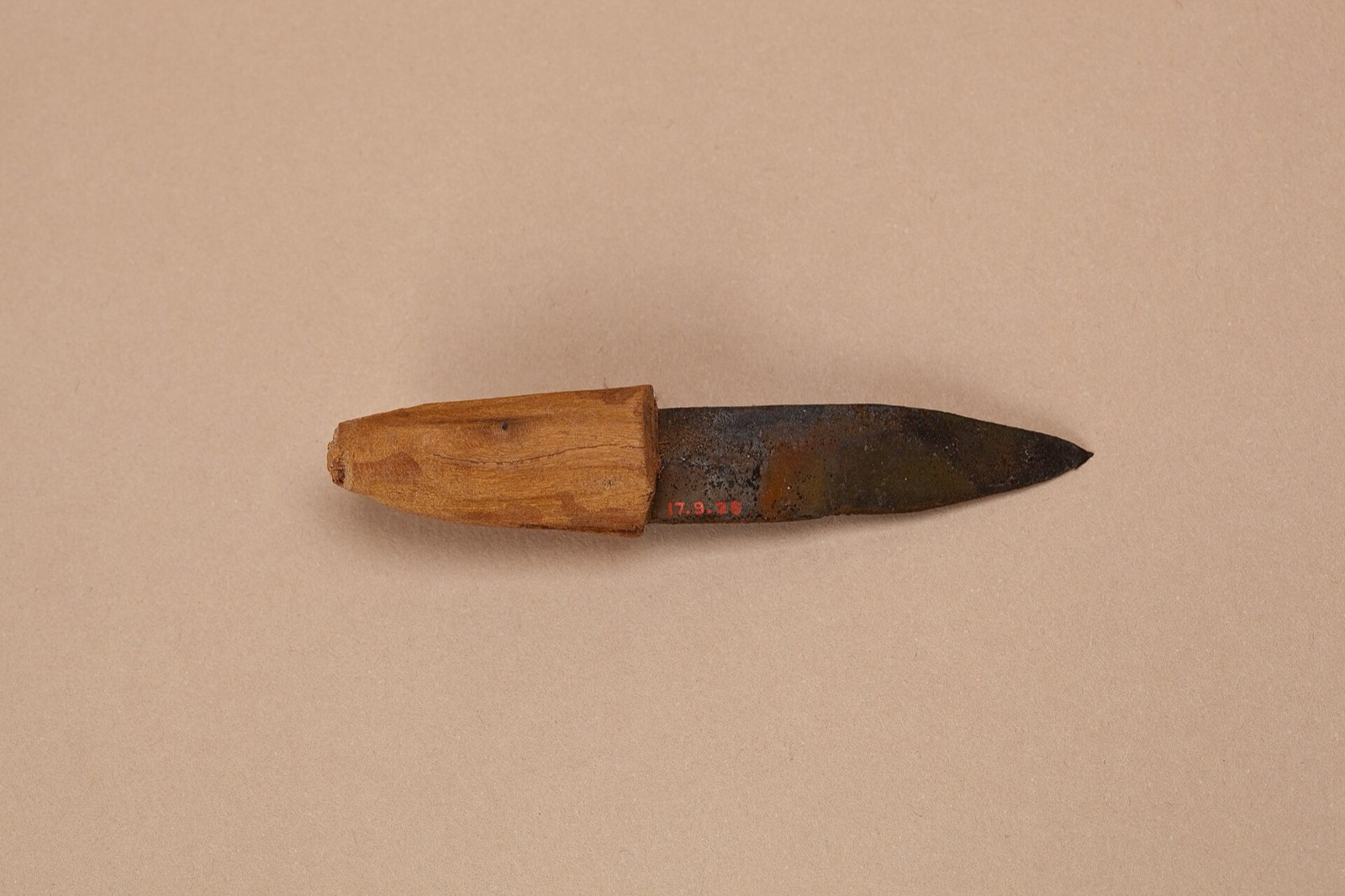
The granite came from Aswan, eight hundred kilometres upstream. Granite cannot be cut with copper. It was worked by pounding with balls of dolerite, a harder stone, and by drilling and sawing with copper tools fed with quartz sand as an abrasive — the copper carries the sand, and the sand does the cutting.
Blocks moved on wooden sledges, dragged over prepared trackways. A well-known painting in the tomb of Djehutihotep at Deir el-Bersha shows a colossal statue on a sledge hauled by 172 men in four rows — and, importantly, a man standing on the sledge’s front pouring liquid onto the sand in front of the runners.
That detail was long read as ritual. It is mechanics. Wetting sand to the right degree dramatically reduces the friction of a sledge running over it — the water forms bridges between grains, stiffening the surface so that the sledge stops ploughing up a heap of sand ahead of itself. Laboratory work has confirmed the effect and put the reduction at roughly half, with the optimum at a fairly narrow moisture content. Someone at Giza worked that out empirically and it became standard practice.
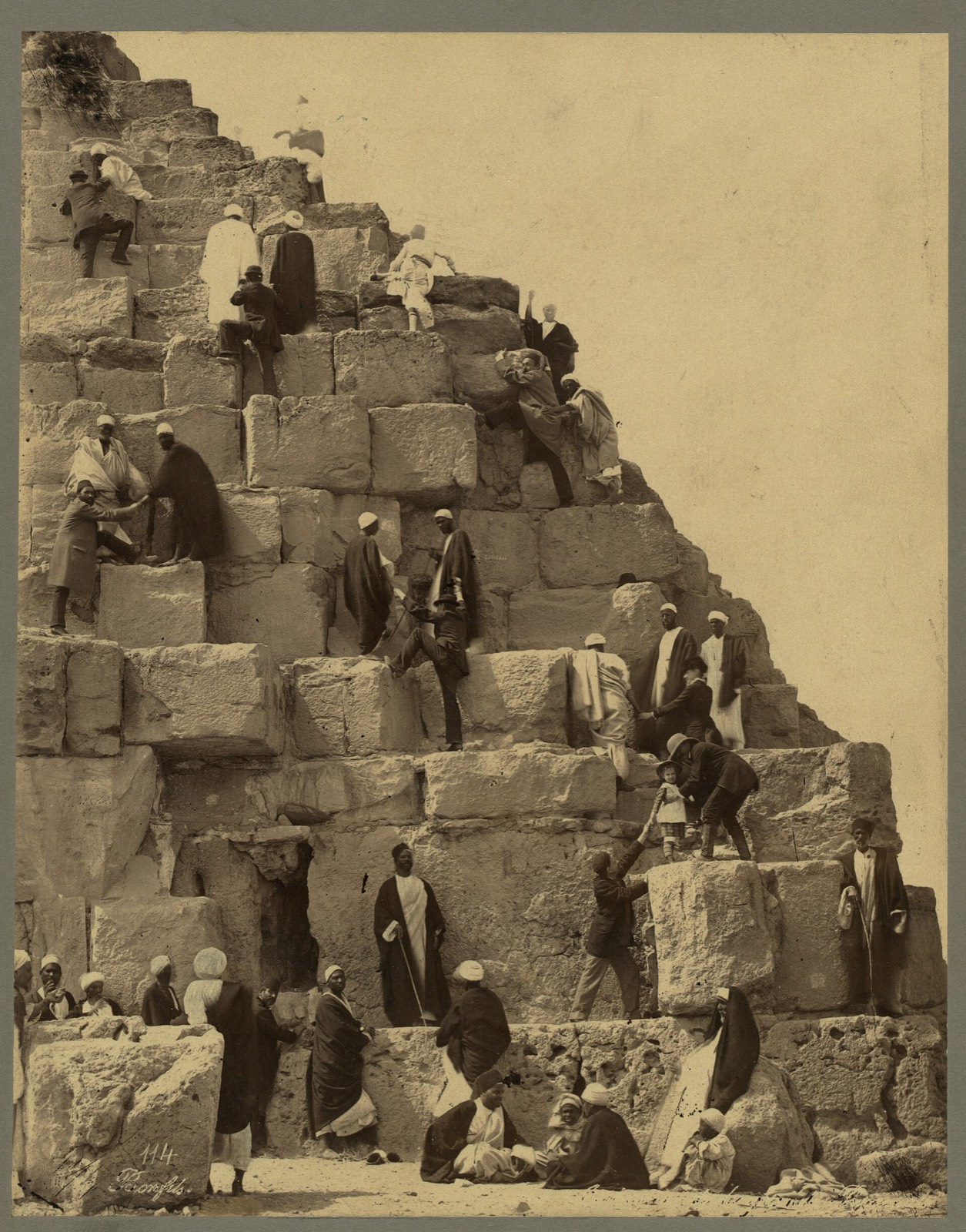
How the blocks then got up is the genuinely open question. A single long straight ramp to the top of the Great Pyramid would need more material than the pyramid itself. The serious candidates are a straight ramp used only for the lower courses combined with something else above; ramps wrapping around the outside of the structure; and an internal spiral ramp within the masonry. None of the three is proven, and they are not mutually exclusive — the method almost certainly changed as the building got higher and the courses got smaller.
Who did the work
The workers’ town at Heit el-Ghurab, south-east of the Sphinx, has been excavated since the late 1980s. It contains barracks-like galleries, bakeries capable of industrial output, a fish-processing area, breweries, and administrative buildings — the physical infrastructure for feeding thousands of people.
The workers were organised into named gangs, and they wrote their names on the stones. Graffiti in the relieving chambers of the Great Pyramid record crews called things like Friends of Khufu and Drunkards of Menkaure — the labour equivalent of a team name.
The nearby cemetery is decisive. The workers were buried in tombs, with grave goods and offerings, within sight of the king they served. Their skeletons show heavy labour, but also healed fractures and successful surgery — evidence of long-term medical care. This is not how a society treats disposable slaves. It is how it treats a valued, conscripted, taxed workforce.
The Friends of Khufu.