Section 01
The Great Pyramid
Built for Khufu around 2560 BCE. It held the record for the tallest structure on earth for roughly thirty-eight centuries, and it is still the heaviest building ever raised by hand.
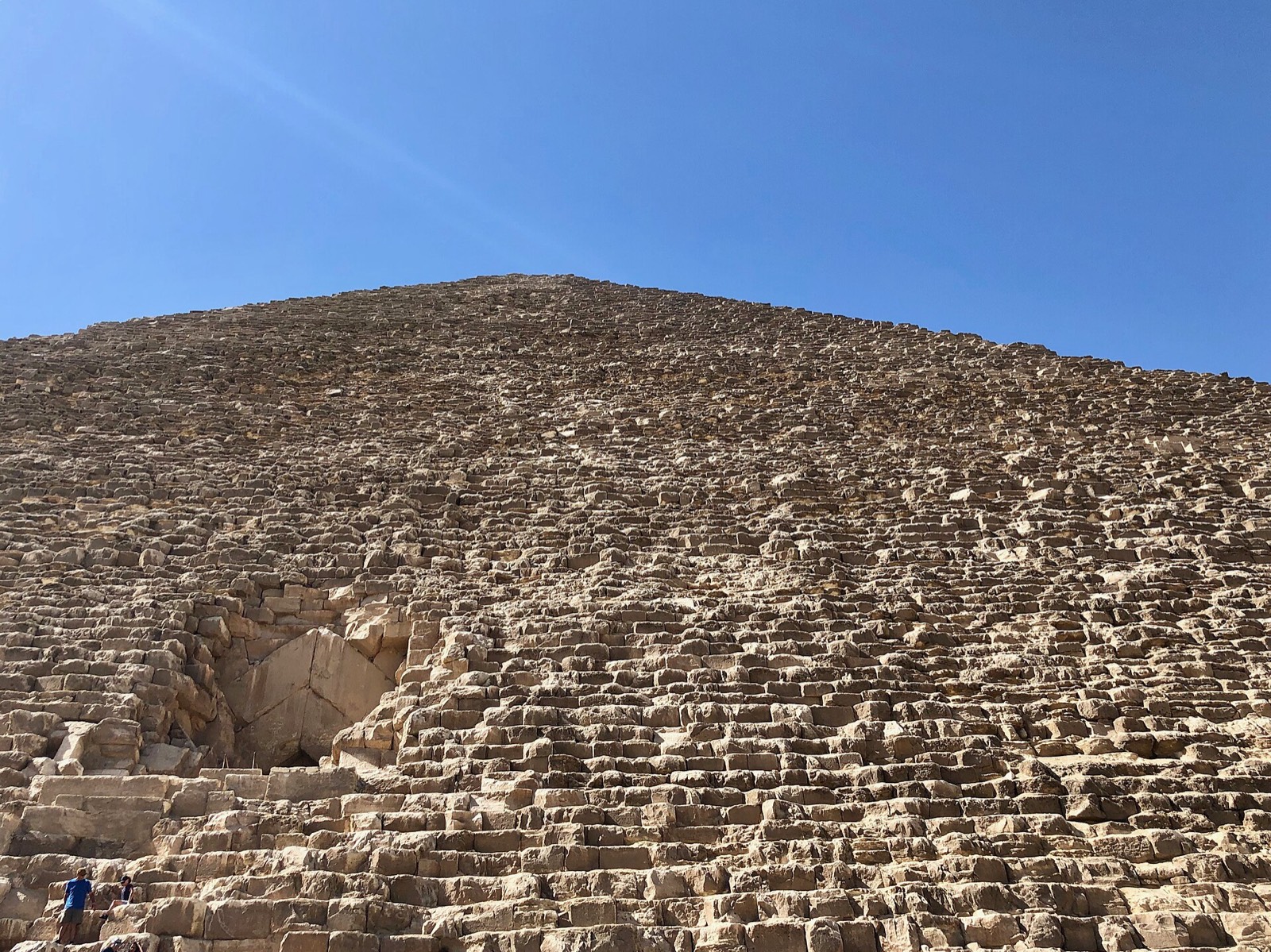
The four sides differ by less than 60 cm.
280 royal cubits. Now about 138.5 m.
A seked of 5½ palms per cubit of rise.
Across a footprint of more than five hectares.
The most impressive thing about the Great Pyramid is not its size. It is that a structure this large was set out this accurately, with no instrument more complex than a plumb line, a set square, a measuring cord and a sight.
The base is level to within about two centimetres across a square of more than five hectares — most likely achieved by cutting a shallow grid of channels into the bedrock, flooding them, and marking the waterline. The sides are aligned to true north within a few arcminutes, an error small enough that it is easier to explain by stellar observation than by anything solar. One well-supported proposal is that the builders watched two circumpolar stars come into vertical alignment and dropped a plumb line against them.
Flinders Petrie, who measured the pyramid properly for the first time in 1880–82, spent two seasons living in a rock-cut tomb nearby and working mostly at night to avoid heat distortion in his instruments. His figures are still cited.
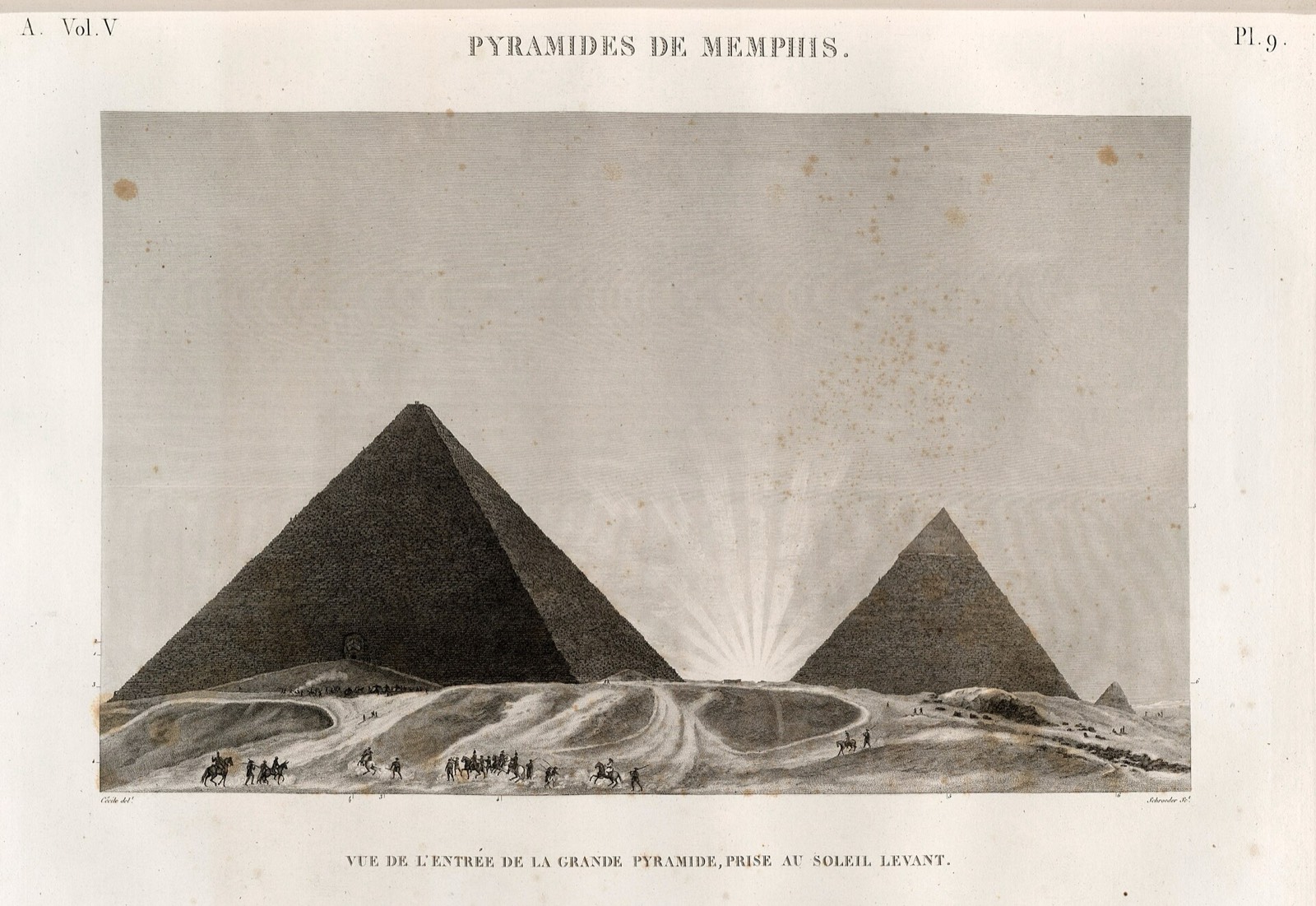
Almost every other pyramid puts its burial chamber underground. Khufu’s has three chambers at three different levels, and the plan appears to have been changed at least twice while building was under way.
A descending passage runs from the north face down through the masonry and into the rock, ending in an unfinished subterranean chamber that was abandoned. Part-way down, an ascending passage branches upward — it was sealed after the funeral with granite plugs slid down from above. That passage leads to the Grand Gallery: a corbelled corridor 46.7 metres long and 8.6 metres high, each course of its walls oversailing the one below until the gap at the top is narrow enough to be bridged by single slabs. It is the finest piece of masonry in the building.
At its top is the King’s Chamber, built entirely of Aswan granite. Above the ceiling sit five hollow relieving chambers stacked one on another, capped by a gabled pair of slabs, all of it there to divert the weight of the masonry above away from the flat granite roof. Quarry marks daubed on the walls of those spaces — invisible until Howard Vyse blasted his way in during 1837 — include the cartouche of Khufu, and are the only inscription in the whole pyramid naming its owner.
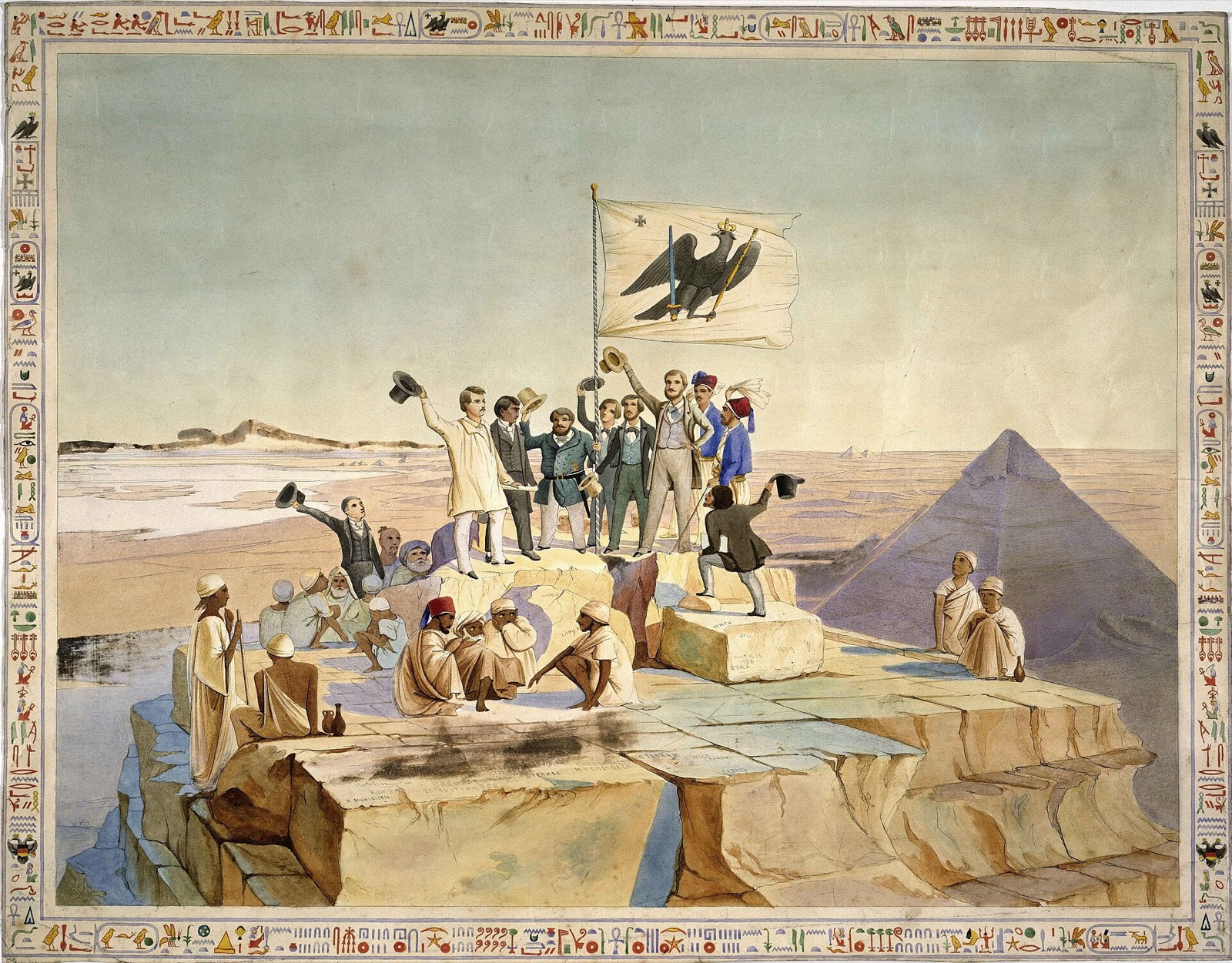
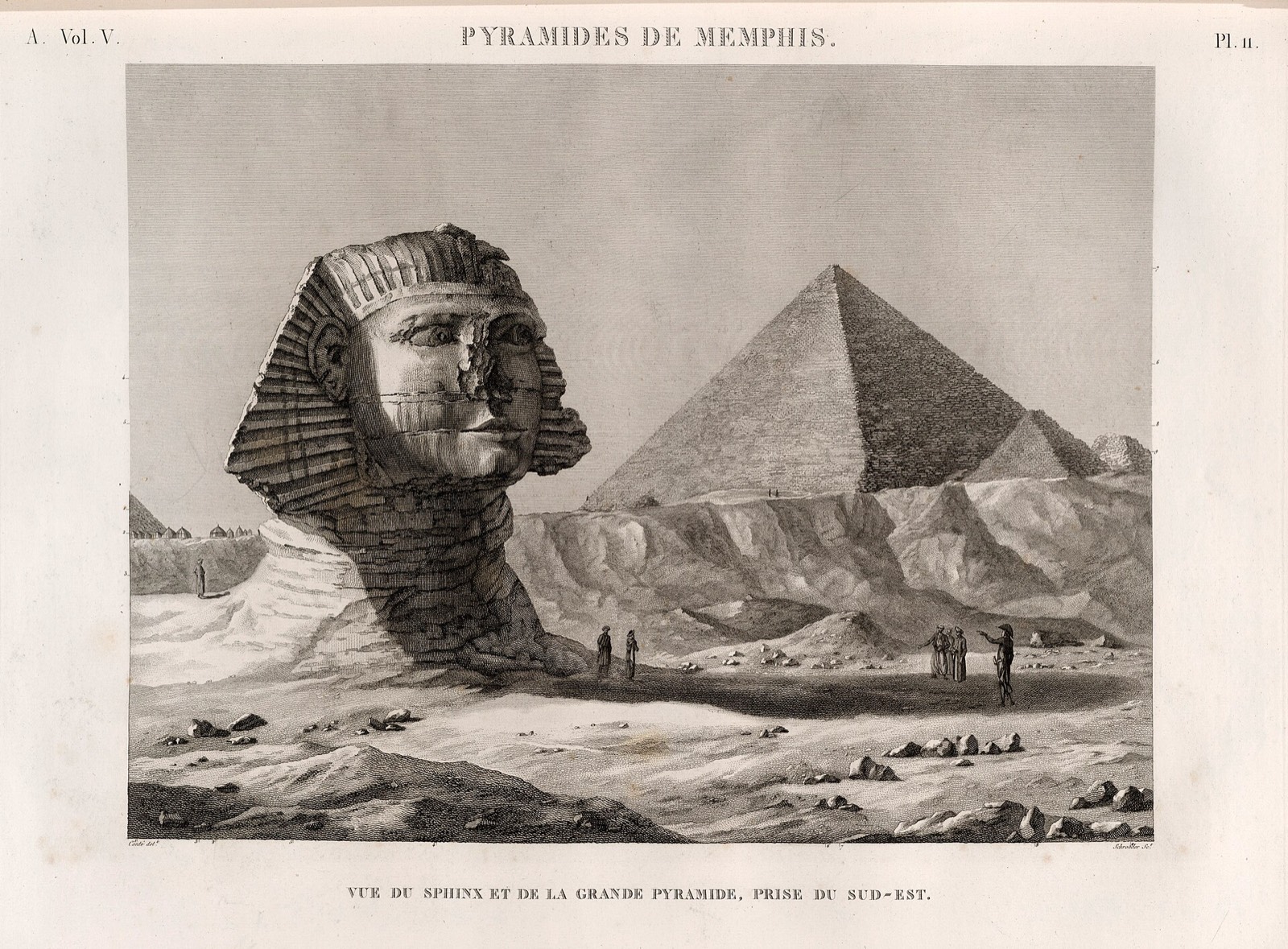
A hundred thousand men laboured constantly, and were relieved every three months by a fresh lot.
He was wrong, or was told wrong. The excavated workers’ town south-east of the pyramids supports a permanent workforce in the low thousands, swelled seasonally by conscripted labour — perhaps twenty to thirty thousand people at peak, housed, fed and organised into named gangs. Not a hundred thousand, and not slaves.
The boat
In 1954, clearing rubble along the south face, the archaeologist Kamal el-Mallakh found a sealed pit cut into the bedrock. Inside, packed in thirteen layers, were 1,224 pieces of cedar — a complete ship, dismantled, with the rope still present.
Reassembled over more than a decade, it is 43.6 metres long, sewn together with rope rather than nailed, and shows signs of having been in water. It is the oldest intact vessel of its size anywhere. In 2021 it was moved across the plateau to the Grand Egyptian Museum on a purpose-built transporter, at a walking pace, over ten hours.